
Introduction
Traditional compliance has many restrictions. They are outdated, costly, slow, repetitive, lengthy, manual, error-prone, and do not adapt easily to change. In a nutshell, manual compliance is risky. According to the Cloud Security Alliance (CSA), “Artificial Intelligence (AI) can transform cybersecurity compliance, enhance risk management, and prepare businesses to face new challenges as it makes its way into our personal and professional lives.” On the other hand, AI is not just a tool. Instead, it is a revolutionary force upgrading compliance by making it automated, proactive, and fast. Its implementation is leading to reduced cost, minimized risks, and real-time regulatory adherence. This article explores the growing complexity of cybersecurity regulations in 2026, how AI is transforming traditional compliance processes, the key ways AI drives cybersecurity regulatory compliance, and the future of AI-enabled GRC: opportunities, challenges, and best practices.
The Growing Complexity of Cybersecurity Regulations in 2026
In 2026, the latest outlook on cybersecurity regulations reveals unprecedented challenges reshaping the cybersecurity landscape. Cybersecurity regulatory standards are complex due to inconsistent regulations and a patchwork of overlapping, leading to higher compliance costs and frequent audits. The advent of AI is playing a crucial role in cyber laws and regulations. In fact, cybersecurity compliance is undergoing a mandatory shift due to AI. Auditors are now taking into account new advanced standards aimed at addressing compliance management and monitoring. There are several prominent cybersecurity regulatory standards, including SOC 2, NIST CSF/RMF, ISO 27001, FISMA, and GDPR. The following sections delve into the details.
SOC 2
The framework is a scheme created by the American Institute of Certified Public Accountants (AICPA). It focuses on safeguarding an organization's customer data, confidentiality, and privacy by reporting on controls over system security, availability, and processing integrity.
GDPR
GDPR stands for the General Data Protection Regulation. It’s an European Union (EU) regulation that protects EU citizens’ data. Organizations must ensure compliance with GDPR. Otherwise, they have to face heavy penalties and reputational damage.
NIST CSF/RMF
Orchestrated by the National Institute of Standards and Technology. This framework makes use of five (5) core functions, namely: Identify • Protect • Detect • Respond • Recover NIST CSF focuses on compliance, risk management, supply chain, and progress measurement.
ISO 27001
This framework is the leading international cybersecurity standard recognized by the ISO for information security management systems. This framework is a set of requirements for the definition, operation, implementation, and improvement of an Information Security Management System (ISMS).” There are common trends in the corporate world. AI implementation now spans numerous business processes, including automation, data management, and vendor management. Consequently, AI is embedded in third-party tools at scale, leading to its integration into safety frameworks and standards. Furthermore, different compliance standards now include similar controls. This is caused by businesses' frequent regulatory updates as they attempt to keep up with technological advancements. Teams are drained by the resource-intensive nature of audits, and reputational damage from business non-compliance continues to rise.
How AI Is Transforming Traditional Compliance Processes
AI integration into Governance, Risk, and Compliance (GRC) augments compliance experts' efforts and enables a shift from periodic/point-in-time audits to continuous compliance and real-time monitoring. Here are some of the ways AI is transforming traditional compliance: ● Automation of repetitive tasks: AI-driven automation assists companies in carrying out repetitive tasks like evidence collection, control testing, and reporting. Allowing auditors to focus on deeper analysis. ● Predictive capabilities: AI forecasts compliance gaps and prioritizes risks before violations occur. For example, AI can predict access control failures before humans detect them. ● AI Integrates and analyzes data from existing security stacks such as SIEM, EDR, CSPM, etc., to identify trends and provide security teams with unified visibility. This contributes significantly to the drastic reduction in audit preparation time (from weeks to days) and to reduced human error.
Key Ways AI Drives Cybersecurity Regulatory Compliance
AI is transforming cybersecurity regulatory compliance capabilities in several key areas: ● Continuous Monitoring & Anomaly Detection: Machine learning powers AI tools to enable continuous, 24/7 analysis of log files, behaviors, and configurations to maintain control. They can sound alarms the moment potential violations are detected. ● Automated Risk Assessment & Predictive Analytics: AI helps organizations forecast and prevent issues through predictive analytics. It helps map threats to regulatory controls and suggest remediations before risks materialize. ● Audit Automation & Evidence and Policy Management: AI dashboards can visualize compliance data, analyze historical data & policy updates, and generate audit-ready reports across multiple frameworks simultaneously.
The Future of AI-Enabled GRC: Opportunities, Challenges, and Best Practices
AI delivers a wide range of advantages in GRC, thereby transforming compliance and improving efficiency. Some key benefits include reduced cost, scalability, improved decision-making, 24/7 monitoring, faster innovation, and making compliance a competitive advantage. Although AI has given organizations a more defensive foothold in compliance. It also enables threat actors to automate and personalize threats on a wide scale. A few examples of AI-induced cyber threats: Adversarial AI and Model Poisoning, Large-Scale Automated Vulnerability Exploitation, AI-Enhanced Phishing and Social Engineering, and so on. Best practices for AI deployment in 2026: • Adopt AI-powered GRC platforms such as CyberGuard. • Implement robust AI governance (including inventory, risk classification, and testing). • Choose tools with strong integrations and multi-framework support. • Build cross-functional teams (compliance, security, and legal).
The Bottom Line
This article has taken a deep dive to understand the role of AI in cybersecurity compliance. As a result, it has been realized that AI is revolutionizing regulatory compliance. In fact, this technology is redefining cybersecurity across organizations of all sizes, from small and medium-sized enterprises (SMEs) to multinational companies. AI can automate policy creation, evidence collection, and the overall compliance process with AI-powered tools, such as CyberGuard. Organizations that embrace AI-powered compliance will not only avoid penalties but thrive in a high-threat, highly regulated digital landscape.
Sigma Technology Partners – Your Best Bet
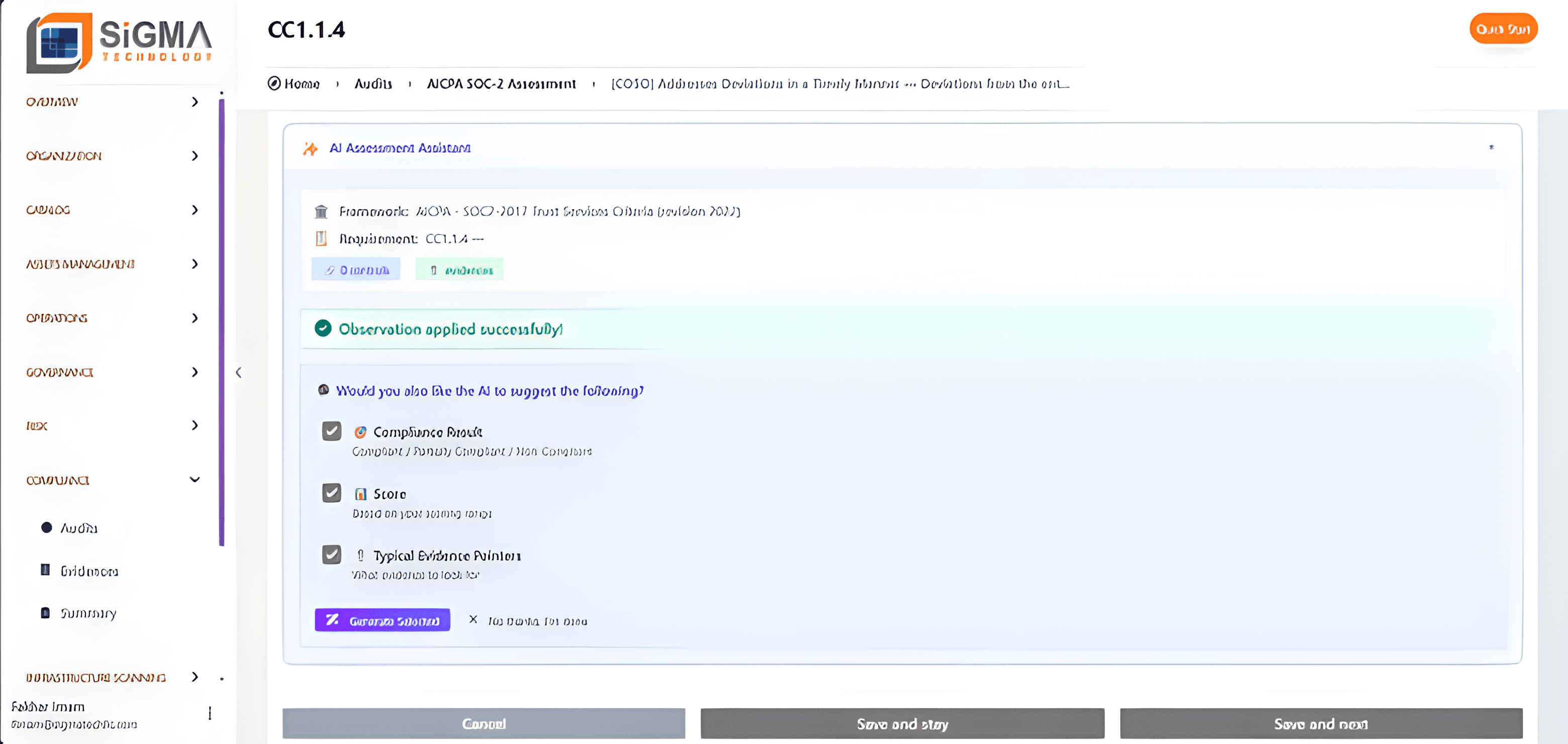
Are you looking for an AI-powered cybersecurity tool? Sigma Technology Partners provides you with the next-generation AI-enabled CyberGuard tool. CyberGuard includes an AI Assessment Assistant, which: • Assist the assessor with suggested verbiage and artifacts, and automatically analyzes evidence to complete the assessment response. • Identifies gaps and missing evidence in real time. • Saves significant time and resources and ensures consistent, objective assessments. Improves audit readiness and reporting speed. • Faster assessment maturity with lower effort and higher confidence. Is that something you are looking for? Contact the Sigma Technology Partners team to book your demo and get peace of mind with automated compliance.